The Visual Language of Modern Data: Leveraging Icon Sets for Communication
In today's digitally-driven environment, the ability to convey complex ideas swiftly and clearly is paramount. Visual elements, particularly icons, have become a fundamental part of this communication toolkit. They serve as a universal shorthand, bridging gaps between technical and non-technical audiences. A specialized collection, such as a comprehensive data center icon pack, provides a cohesive visual vocabulary for depicting the intricate ecosystem of services, hardware, and concepts that power our world.
Beyond Decoration: The Functional Role of Icons in Design
Icons are far more than simple decorations. They are functional components that guide users, enhance comprehension, and structure information. When dealing with subjects like cloud infrastructure, network architecture, or server management, text alone can be dense and intimidating. A well-designed icon set translates these abstract notions into tangible visual symbols. This translation reduces cognitive load, allowing viewers to grasp relationships and hierarchies at a glance. For professionals creating analytical reports or system documentation, this visual efficiency is not a luxury; it's a necessity for accurate and timely understanding.
Characteristics of a High-Utility Icon Collection
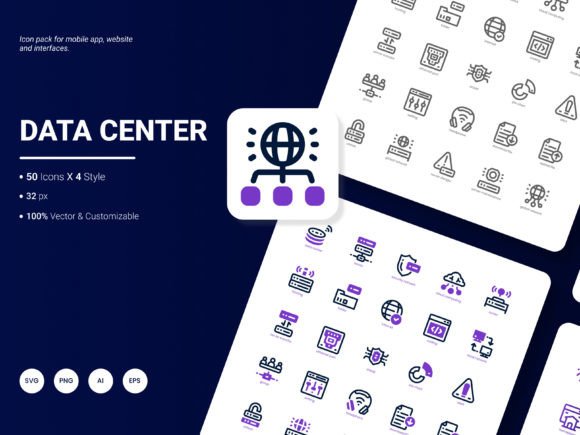
To be genuinely effective, an icon pack must possess several key attributes. First is comprehensiveness. A set offering 200 individual symbols covering popular services and ideas provides broad coverage, reducing the need to source images from disparate places. Second is versatility in format. Availability in multiple file types—such as AI, EPS, SVG, PNG, PDF, and JPG—ensures compatibility across different software platforms and use cases, from web development to printed presentations. Third is stylistic consistency. A pack designed with a fresh, trendy aesthetic ensures all icons share a common visual language, maintaining professional cohesion across an entire project.
Furthermore, practical features like editability and flexible integration are crucial. The ability to recolor, resize, or slightly modify an icon without degrading its quality allows designers to adapt the assets to specific brand guidelines or contextual needs. This adaptability makes the resource a long-term asset rather than a one-time use item.
Primary Applications and Real-World Use Cases
The utility of a robust data-themed icon collection spans numerous fields and mediums. Its application is defined by the user's goal to communicate information about technology infrastructure effectively.
Enhancing Digital Interfaces and Experiences
For website designers and mobile application developers, these icons serve as navigational aids and feature indicators. An icon representing "database" or "load balancing" can instantly label a service offering or feature within a control panel. This use improves user experience (UX) by making interfaces intuitive and reducing reliance on lengthy textual descriptions. The scalability of vector formats like SVG means icons remain crisp and clear at any screen resolution, a critical requirement for responsive web design.
Empowering Business and Technical Communication
In the corporate and educational spheres, presentations and analytical reports frequently need to explain data flow, cloud migration strategies, or security layers. Integrating a stylized icon set into slides or documents transforms bullet points into engaging, memorable visual narratives. Educators and researchers can use these visuals to illustrate concepts in training materials or published papers, aiding comprehension for students and peers. Business owners pitching a tech-focused proposal can use the icons to create professional, easy-to-understand infographics that highlight their system's architecture or service stack.
Strategic Advantages for Creators and Professionals
Adopting a pre-made, high-quality icon pack offers several tangible benefits over creating custom icons or using fragmented collections.
- Time and Resource Efficiency: Designing 200 consistent, detailed icons is a significant undertaking. A ready-made pack saves countless hours of design work, allowing teams to focus on core project tasks.
- Guaranteed Visual Consistency: All icons share the same design principles, line weights, and stylistic approach. This uniformity projects professionalism and care in any final product.
- Broad Conceptual Coverage: With symbols for popular services and ideas, the pack likely includes icons for both foundational concepts (like servers and networking) and modern services (like specific cloud platforms or cybersecurity tools), making it relevant for a wide range of projects.
- Simplified Collaboration: When entire teams or departments use the same asset pack, it ensures everyone is "speaking the same visual language," streamlining the collaborative creation of documents, websites, and presentations.
Considerations for Selection and Implementation
While the advantages are clear, effective use requires thoughtful consideration. It's important to assess whether the icon style aligns with the overall branding or tone of the project—a trendy, fresh set might not suit a project requiring a more classic, conservative aesthetic. Furthermore, understanding the licensing terms is essential, especially for commercial products or widely distributed applications. The technical consideration involves choosing the correct file format for the task: SVG for scalable web use, PNG for raster applications with transparency needs, or EPS for high-quality print layouts.
The Evolution of Visual Assets and Future Directions
The demand for high-quality, thematic icon collections continues to grow as digital communication becomes more visual. Observing current trends can inform what users might seek in future updates of such packs.
One area of potential expansion is the inclusion of icons representing emerging technologies and paradigms, such as edge computing nodes, quantum computing symbols, or specific icons for different AI model types. As sustainability becomes a core business concern, icons illustrating green data centers, energy-efficient hardware, or carbon footprint metrics could be highly valuable. Another suggestion is the development of more nuanced state variants—icons showing active, inactive, warning, or error states for the same service—which would be incredibly useful for dynamic dashboards and monitoring systems.
Additionally, while four styles offer good variety, some projects might benefit from even more stylistic options, like a strictly outlined version, a more filled and solid variant, or a duo-tone style. Providing icon sets in organized, nested groups—like "security icons," "storage icons," "network icons"—within the pack can also improve usability, helping designers find relevant symbols faster.
Integrating Icons into a Cohesive Workflow
The final step is the seamless integration of these assets into a creator's workflow. For a graphic designer, this might involve importing the EPS or AI files into Adobe Illustrator to incorporate them into a larger illustration. A web developer would integrate the SVG icons directly into code, perhaps animating them slightly with CSS for interactive effect. A business analyst might drag and drop PNG icons into a PowerPoint template for a quarterly infrastructure review. The common thread is that the icon pack acts as a reliable, versatile component library, ready to be deployed wherever clear visual communication about data and technology is required.
The ongoing refinement of such resources, informed by user feedback and technological shifts, ensures they remain powerful tools for anyone tasked with explaining the complex, invisible engines of our digital age. By investing in a well-crafted visual language, professionals across disciplines empower their audience to see, understand, and engage with information in a more direct and meaningful way.