Visualize Your Ideas with Chart and Diagram Icons
In today's fast-paced digital world, clear communication is paramount. Whether you're explaining a complex business process, sharing data insights, or designing a user-friendly mobile app, visual elements can bridge the gap between information and understanding. This is where a well-designed set of Chart and Diagram Icons becomes an indispensable toolkit for creators. These icons are more than just decorative graphics; they are a universal language of structure, flow, and relationship.
What Exactly Are Chart and Diagram Icons?
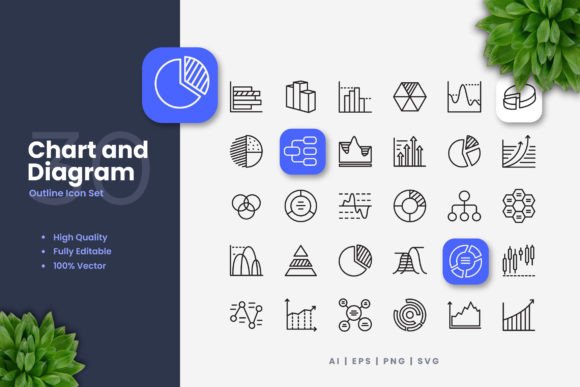
Unlike generic icon sets, Chart and Diagram Icons are specifically crafted to represent concepts related to data visualization, process mapping, and systematic organization. Think of classic symbols like pie charts, bar graphs, flowcharts, mind maps, Venn diagrams, organizational hierarchies, and network nodes. A dedicated collection provides a cohesive family of these symbols, designed with a consistent style and simple, clean aesthetic. This consistency ensures that when you use them across a project, they work harmoniously to tell a visual story.
The core purpose of these icons is to abstract and simplify. They allow you to convey the idea of a "chart" or a "diagram" without necessarily displaying the specific data itself. This is incredibly useful for UI buttons, instructional materials, or infographics where you need to indicate functionality like "view analytics" or illustrate a step in a process before the detailed content is added.
Key Characteristics and Features of a Quality Set
A professional set of Chart and Diagram Icons is built for utility and flexibility. Here are the defining features you should look for:
- High-Quality Vector Design: Each icon is created as a vector path, not a pixel-based image. This means it's mathematically defined, allowing for infinite scalability without any loss in quality or sharpness.
- Fully Customizable: True value lies in customization. Being vector-based, you can easily change colors to match your brand palette, adjust stroke weights for boldness or delicacy, and even modify shapes if needed, using standard vector software.
- Editable Stroke: The lines and outlines of the icons are not fixed. You can make them thicker for emphasis on a poster or thinner for a sleek web interface, all within your editing program.
- Easy to Implement: The "drag and drop" nature of vector files means you can quickly import them into your design project, speeding up your workflow significantly.
The Practical Value Across Industries and Projects
The versatility of Chart and Diagram Icons is vast. They serve as a visual shorthand for professionals, educators, and creators in countless scenarios.
For Digital Products and User Interfaces
In website and mobile app design, these icons are perfect for feature sections. A bar graph icon can label a "Statistics" page, a flowchart icon can represent a "Process" tutorial, and a network icon can denote "Connections" or "Social Features." They enhance UX by providing immediate visual cues about the content or functionality behind a button or menu item.
For Print and Marketing Materials
In flyers, banners, posters, and corporate reports, Chart and Diagram Icons help break down complex information into digestible pieces. They can be used to create compelling infographics that guide the reader through a sequence or comparison. Their clean design ensures they remain clear even when printed at various sizes.
For Educational and Publishing Content
Authors and educators can use these icons in books, e-learning modules, and presentations to illustrate theoretical concepts. Diagramming ideas like cycles, hierarchies, or relationships becomes much easier when you have a library of precise icons to insert into your diagrams, rather than drawing each element from scratch.
For Business and Strategy Communication
Business owners and consultants often need to map out strategies, organizational structures, or project plans. Using a consistent set of icons for these internal documents fosters clarity and professionalism, making the documents easier for teams to understand and follow.
Evaluating Your Needs and Using the Icons Effectively
While Chart and Diagram Icons offer tremendous utility, it's wise to consider their application thoughtfully.
- Assess Your Project's Visual Language: Do you need a minimalist, modern look or something more detailed? The simple and clean design of most sets makes them adaptable, but ensure the style aligns with your overall aesthetic.
- Understand the File Formats: A good pack includes multiple formats. The AI (Adobe Illustrator) and EPS files are for deep editing in vector programs. The SVG is great for modern web use, as it's also scalable. The PNG with transparency provides a ready-to-use bitmap for situations where editing isn't required.
- Consider Your Software Proficiency: To truly customize—resizing, color changing, stroke editing—you will need basic familiarity with software like Adobe Illustrator or CorelDRAW. The "Readme.txt" file often contains helpful instructions.
- Note the Scope: Remember that a preview mockup is typically not included. The product is the icon set itself—the raw, editable components for you to build your designs with.
Real-World Application Scenarios
Imagine a small business creating a new onboarding manual. Instead of describing the company structure with text alone, they can use organizational chart icons to visually represent departments and roles. A blogger writing about data literacy can use simple chart icons within the article to visually segment sections about different graph types. A developer prototyping an analytics dashboard can use these icons in the wireframe to show where different data visualizations will appear, before the live data is connected.
Who Benefits Most?
Ultimately, anyone who needs to communicate information systematically will find value. This includes:
- UI/UX Designers and Web Developers crafting intuitive interfaces.
- Marketing and Content Creators producing engaging social media and advertising materials.
- Business Analysts and Consultants preparing reports and strategy documents.
- Educators and Authors developing instructional content.
- General Consumers and Online Users undertaking personal projects, like creating a family tree or planning a project.
A Tool for Clarity, Not a Replacement for Data
It's important to recognize that Chart and Diagram Icons symbolize the container or the type of visualization. They are the signposts pointing to where a detailed pie chart with actual percentages will go, or indicating that a process flowchart exists. Their strength is in signaling and structuring. They don't replace the need for accurate, well-designed data charts themselves, but they powerfully set the stage and framework for them.
By investing in a high-quality, customizable set of Chart and Diagram Icons, you equip yourself with a fundamental visual communication tool. Their simple, clean design ensures they integrate seamlessly into diverse mediums, from mobile apps to printed flyers. And because they are editable vectors, they empower you to adapt them perfectly to your unique vision, making your ideas not just visible, but vividly clear.