The Resurgence of Symbolism: Why Medieval Icons Matter in Modern Design
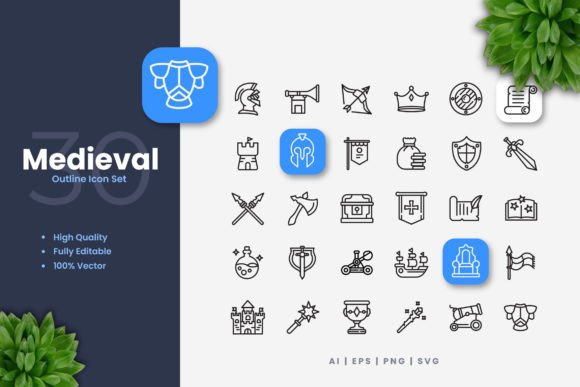
In a digital landscape saturated with fleeting trends and minimalist abstractions, a distinct aesthetic is carving out a significant niche. The Medieval Icons collection represents more than a simple stylistic choice; it is a deliberate return to symbolism, clarity, and narrative depth. This curated set of icons, designed with a simple and clean aesthetic, taps into a deep well of historical visual language, repurposing it for contemporary communication across websites, mobile apps, books, social media, infographics, flyers, print, banners, posters, and countless other mediums.
Bridging Historical Narrative and Modern Utility
What exactly are Medieval Icons? They are not mere replicas of Gothic or Renaissance artwork. Instead, they are thoughtfully simplified vector designs that capture the essence of medieval symbolism—the heraldic shields, the stylized flora and fauna, the tools, the architectural elements, and the emblematic representations of concepts like chivalry, craft, and community. The design philosophy strips away excessive detail while preserving the iconic strength and recognizability of the original forms. This creates a visual library that feels both timeless and immediately accessible.
This approach fits seamlessly into a broader industry trend moving towards designs with contextual weight. As users become more discerning, generic and anonymous iconography often fails to convey specific meaning or establish a unique brand voice. The narratives embedded in medieval symbols—a castle for security, a quill for authorship, a forge for creation—provide immediate conceptual anchoring. For professionals, marketers, and entrepreneurs, this means communications can gain depth and memorability without sacrificing the clean, uncluttered interfaces demanded by today’s users.
The Alignment with Contemporary Creative and Business Needs
Why are creators paying such close attention to this style? The answer lies in evolving preferences and workflows. The modern creator’s toolkit is inherently flexible and multi-platform. A single project may require assets for a mobile app interface, a printed brochure, and an animated social media video. The 100 vector, fully customizable icons in this collection are built for this exact reality. Their editable stroke and structure mean that resizing, color changes, and stylistic adjustments are not cumbersome tasks but simple operations within vector software like Adobe Illustrator or CorelDRAW.
This technical practicality addresses a fundamental change in expectation: the demand for adaptable ownership. Freelancers and agencies no longer wish to be locked into static, low-resolution asset libraries. They require high-quality design resources they can truly own and mold to fit each unique client brand or project theme. The included file formats—source AI, EPS version 10, SVG, and PNG transparency—ensure seamless integration from professional print workflows to web development environments. The easy drag-and-drop nature of the vectors accelerates production, turning a once time-consuming design task into an efficient, creative one.
From Generic to Meaningful: Practical Applications
Consider a tech startup building an app for historical education. Using generic modern icons might feel anachronistic. Implementing Medieval Icons for navigation—a scroll for “library,” a helm for “leader profiles,” a parchment for “notes”—instantly creates a cohesive and immersive user experience. Similarly, a craft brewery might use the icon set for its labeling and marketing materials, employing barrel, wheat, and crest icons to visually communicate its heritage and artisan approach without lengthy textual explanations.
For marketers and content creators, these icons serve as powerful visual shorthand in infographics and social media posts, where space is limited and attention is competitive. A simple, clean icon of a knight can represent “security” in a financial services infographic more effectively and elegantly than a complex, modern illustration. This connection to larger narratives enriches content without complicating it.
The Larger Trend: Authenticity and Visual Literacy
The relevance of Medieval Icons connects to a larger development in consumer and lifestyle trends: a growing appreciation for authenticity and crafted storytelling. In an age of algorithmic homogeneity, visual elements that carry a sense of history, human craft, and deliberate meaning stand out. They signal a brand’s or creator’s investment in depth. This collection provides the tools to signal that authenticity visually, across every touchpoint.
Furthermore, it aligns with an increased visual literacy among audiences. People are adept at decoding symbols and understanding visual metaphors. The medieval lexicon is surprisingly universal and intuitive, often transcending language barriers. This makes the icon set not only a design asset but also a strategic communication tool for global projects.
Ultimately, the Medieval Icons collection is more than a set of graphics. It is a response to a clear market need for design resources that are simultaneously high-quality, deeply customizable, and rich in pre-loaded meaning. By marrying the symbolic power of the past with the technical flexibility and clean aesthetics required by present-day digital and print workflows, it offers professionals, entrepreneurs, and enthusiasts a way to elevate their visual communication from merely functional to genuinely resonant. The included readme.txt file ensures smooth adoption, completing a package designed not just for use, but for thoughtful, impactful integration into the modern creative process.