The Arrow Infographic Four Step: Your Blueprint for Clear Communication
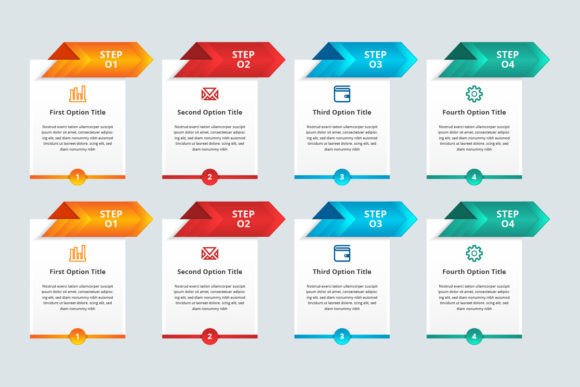
In today’s fast-paced business environment, clarity is currency. Whether you’re pitching to investors, training a team, or mapping out a marketing campaign, your ability to visualize a process is critical. The Arrow Infographic Four Step is a minimalist design template specifically crafted for this purpose. It features a clean, horizontal row of four rectangular elements, each topped with a directional arrow, forming a clear progress bar. This isn’t just a graphic; it’s a communication tool built on the universal concept of four steps to business success.
Why This Simple Template is So Powerful
People gravitate towards this infographic because it solves a common problem: complexity overload. When explaining a sequence or strategy, lengthy text documents or cluttered slides can obscure the core message. The Arrow Infographic Four Step forces distillation. Its structure—four distinct stages in a linear flow—encourages you to identify the essential phases of any project: Foundation, Development, Execution, and Growth. The high-resolution, vector-based files (AI, EPS, SVG, JPG) ensure the graphic remains crisp in any format, from a website banner to a printed report, while the fully editable text, shapes, and colors allow it to seamlessly integrate into your unique brand identity.
Common Pitfalls and How to Navigate Them
Despite its apparent simplicity, there are several nuances often overlooked that can turn a powerful visual into a confusing one. Avoiding these mistakes is key to leveraging the template effectively.
The first, and most frequent, error is mislabeling the stages. Because the template provides four neat boxes, users sometimes force a process into this mold even when it genuinely has three or five critical steps. This compromises accuracy. For example, if your customer onboarding has five key touchpoints, squeezing them into four boxes will omit crucial information. The better approach? Use the four-step structure for high-level strategy (e.g., Awareness, Consideration, Decision, Loyalty) and create separate, detailed graphics for sub-processes. The template is a framework, not a rigid cage.
Another oversight is neglecting the visual hierarchy within the rectangles. Each rectangular element isn’t just a placeholder for text; it’s a canvas. A common mistake is to fill each with a dense paragraph, making the infographic text-heavy and defeating its visual purpose. The practical advice is to treat each box as a headline and a short, impactful supporting statement. Use the arrow above it to symbolize progression, not just decoration. For instance, Step 1’s rectangle might read: “Market Research” with a sub-point like “Identify core customer pain points.” This maintains scannability.
The Gradient and Color Choice: More Than Just Decoration
The gradient vector illustration is a subtle but powerful feature. A common misunderstanding is to choose colors purely for aesthetic appeal, without considering their communicative function. A jarring or poorly progressing gradient can visually disconnect the steps. Imagine a gradient that goes from dark blue to bright red to soft green—the progression feels chaotic, undermining the “step-by-step” message. The corrective approach is to use color logically. Employ a monochromatic gradient (e.g., light to dark blue) to show intensity building, or a harmonious transition (e.g., cool to warm tones) to symbolize a shift from planning to action. Always check that your color choices are accessible and legible against the text.
Furthermore, professionals sometimes download the file and immediately dive into editing without auditing the file structure. The description mentions “well organized,” but this is a feature you must verify and utilize. Opening the .AI or .EPS file in a vector program like Adobe Illustrator should reveal logically grouped layers (e.g., “Arrows,” “Rectangles,” “Text”). A mistake is to edit everything on a single, flattened layer, which makes future adjustments tedious. Before you start, explore the layer panel. Lock background elements you won’t change and isolate text groups. This preserves the editable quality and saves immense time during iterations.
From Download to Application: Ensuring Quality Output
Before committing this graphic to a final presentation or publication, conduct a simple usability check. Scale the graphic to its intended output size. Since it’s 300dpi, it’s excellent for print, but on a website, you’ll need a lower resolution version. A common error is using the massive JPG file directly on a webpage, slowing down load times. The better choice: use the SVG file for web (as it’s scalable and lightweight) and the high-res JPG or EPS for print materials. Also, proofread all text within the graphic context. A typo in an infographic is glaring and can erode the credibility of the entire process you’re illustrating.
Finally, remember that this Arrow Infographic Four Step is a starting point. Its minimalist design is its strength, but a mistake is to leave it too generic. Apply your brand’s fonts and color palette. If your business success steps are unconventional, adapt the shape language slightly—perhaps soften the rectangles for a creative industry or sharpen them for a tech startup. The template provides the discipline of a four-stage flow and clean geometry; you provide the specific strategic thinking and brand personality.
Making the Infographic Work for Your Audience
The ultimate goal is effective communication. Therefore, evaluate your finished infographic not just by how it looks, but by how it functions. Ask: Does the progression feel intuitive? Can a viewer grasp the sequence in under ten seconds? Is the most critical step given appropriate visual weight? By avoiding the pitfalls of forced step-counting, text overcrowding, irrational color progression, and poor file management, you transform this versatile template into a compelling story of progress. It becomes more than a graphic resource; it becomes a clear, confident visual narrative of your path to success, whether you’re an educator mapping a curriculum, a marketer plotting a campaign, or an entrepreneur outlining a startup’s journey.
When used thoughtfully, the Arrow Infographic Four Step template does what all great tools should: it simplifies complexity without losing substance, guiding both you and your audience toward a clearer understanding. That clarity, in itself, is a foundational step to success.