E-Commerce White Color Icon Set: The Versatile Toolkit for Modern Digital Projects
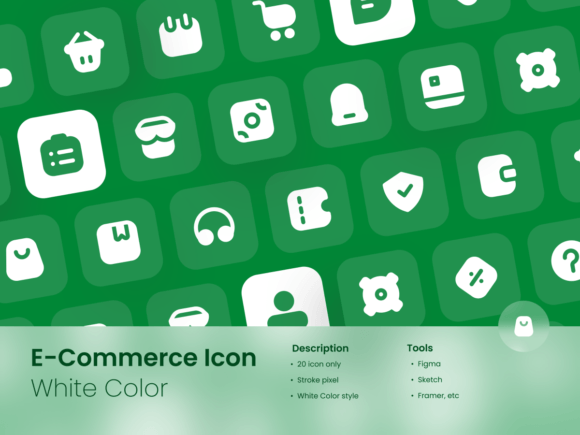
In the world of digital design, clarity and consistency are currencies. A well-chosen icon can convey function, guide a user, and reinforce brand identity in a single glance. The E-Commerce White Color Icon Set represents a focused collection of 20 essential symbols, rendered in a clean white style, designed to serve as a foundational visual language for countless projects. Its relevance stems not from novelty, but from utility; it addresses the universal need for high-quality, adaptable graphic elements that integrate seamlessly into the fast-paced workflows of today's creators and businesses.
The Rise of Minimalism and Functional Visual Communication
Current design trends lean heavily towards minimalism and clarity. Users are inundated with information, and their expectations for intuitive, uncluttered interfaces have risen sharply. A white icon set fits perfectly into this aesthetic. The white color offers a neutral, high-contrast base that stands out against colored or dark backgrounds, a common scenario in modern UI design, app development, and presentation slides. This shift isn't merely stylistic; it's driven by a need for efficiency. Designers and marketers require assets that reduce cognitive load for the end-user while speeding up their own production process.
Furthermore, the bundle's specification for use across UI, infographics, websites, mobile apps, social media, presentations, flyers, print, banners, and posters highlights a key evolution in creative practice: asset consolidation. Professionals no longer maintain separate graphic libraries for web and print, for social media and corporate reports. They seek a single, versatile resource that can be adapted on-demand, saving time and ensuring visual coherence across all customer touchpoints. The E-Commerce White Color Icon Set is built for this unified approach.
What Makes This Icon Set a Practical Asset
The value of this bundle lies in its technical features and the practical implications they have for anyone who uses it. The promise of High-Quality Icon Design and Perfect Pixel integrity ensures that the icons appear sharp and professional at any scale, eliminating the blurry edges or distorted shapes that can plague low-resolution graphics. This is crucial for maintaining brand professionalism, especially when assets might be used on a high-resolution monitor in a web app and later in a large-format printed banner.
The 100% Vector Customizable and Editable Shape features are perhaps the most powerful. Vector graphics are based on mathematical paths rather than pixels. This means they are fundamentally scale-independent. You can enlarge an icon to fill a poster or shrink it for a mobile app button without any loss of quality. For a freelancer creating a client's branding package, this allows one asset to serve dozens of purposes. The editable nature means the icons aren't locked static images; a designer can tweak a shape, combine elements, or adjust a detail directly within software like Adobe Illustrator or Figma to better match a specific project need.
- Easily change the size: This is the direct benefit of vector source files. It empowers rapid iteration during prototyping.
- Easily change the color: While the set is provided in white, the vector format allows the fill color to be altered instantly. A marketer might use the icons in brand blue for a website, then in black for a printed flyer.
- Easily Drag and Drop: This speaks to workflow integration. In tools like Figma or presentation software, ready-to-use PNGs with transparency can be placed directly into layouts, speeding up composition.
The Comprehensive Source File Package: Flexibility in Format
Receiving the source files in a ZIP format containing multiple file types is a standard expectation for professional graphic resources today. Each format serves a distinct purpose in the modern creative pipeline. The Adobe Illustrator (AI) and EPS CC files are the master vector files, ideal for deep editing and print production. The SVG File is the web-friendly vector format, essential for developers implementing icons directly into code for websites or apps, as SVGs are scalable and often perform better than image files.
The inclusion of PNG Transparency files provides ready-to-use raster images for situations where vector editing isn't needed, such as quick social media graphics or slides in PowerPoint. Notably, the provision of a FIGMA FILE reflects the tool's dominance in contemporary UI/UX design and collaborative team workflows. Having assets native to Figma means designers can incorporate them directly into their interactive prototypes and design systems without conversion, a significant time-saver in agile environments.
Real-World Applications and Recommendations
Consider an entrepreneur launching an online store. They could use icons from this set for their website's navigation (shopping cart, user account, search), for their product feature infographics (secure payment, delivery truck, customer support), and for their promotional Instagram posts. Using the same icon set across all these platforms creates a cohesive visual narrative that customers subconsciously recognize, building trust and familiarity.
For an educator creating a course on digital marketing, the icons could be used throughout presentation slides to visually anchor topics like "e-commerce," "analytics," or "social media marketing," making the material more engaging and memorable. A blogger might use the PNGs to enhance article headers or featured images when writing about online shopping tips.
The recommendation is straightforward: treat this icon set as a core component of your digital asset library. Start by exploring the vector source files in Illustrator or Figma to understand their full editable potential. Then, extract the specific format you need for each task—SVG for your web developer, PNG for your content manager, EPS for your print designer. This approach maximizes the return on a single, modest investment.
Beyond E-Commerce: The Universal Utility of Core Symbols
While labeled an e-commerce set, the icons likely cover universal concepts like payment, security, communication, delivery, and user action. This makes them applicable far beyond online store projects. Any service-based website, app, or presentation that involves transactions, user interaction, or process explanation can benefit. The white style acts as a blank slate, ready to be colored by your brand's palette and contextualized by your content.
The attention paid to such resources today is a reflection of a matured digital ecosystem. Early web design often struggled with inconsistent, low-quality graphics. Now, there is a widespread understanding that professional visuals are non-negotiable for credibility and user experience. A dedicated, high-quality icon set is no longer a luxury for large teams; it's a practical necessity for solo freelancers, small business owners, and in-house marketers alike. It democratizes good design, allowing those without extensive graphic design training to implement polished, consistent visuals.
In essence, the E-Commerce White Color Icon Set bundle is more than a collection of 20 images. It is a flexible, multi-format toolkit designed for efficiency and quality. It aligns with the minimalist visual trends and cross-platform workflows that define current digital creation. By providing the foundational assets in editable, scalable formats, it empowers professionals and creators to focus on their core message and strategy, knowing their visual communication is built on a solid, adaptable, and professional graphic foundation.