Beyond Checkmarks: The Functional Art of Notes and Tasks Icons
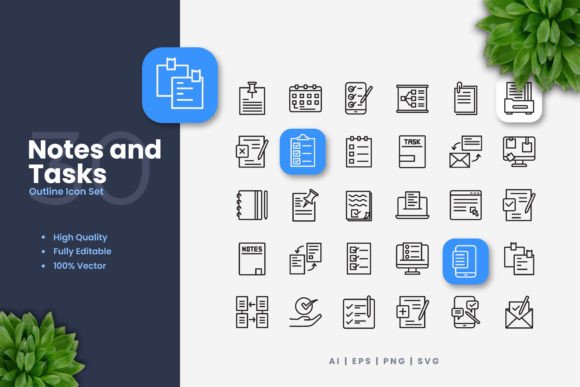
In the visual lexicon of digital and print communication, icons are the universal shorthand. Among the most essential categories are those representing notes and tasks. These symbols—a stylized notepad, a checklist, a simple reminder bell—do far more than decorate an interface or a page. They organize, instruct, prioritize, and guide. This exploration is not about a specific set of graphics, but rather the conceptual and practical universe of notes and tasks icon design: its characteristics, its profound utility across countless fields, and the considerations for anyone looking to implement or create such assets.
The Core Characteristics of Effective Task and Note Icons
Effective icons in this category share distinct traits. First is instant recognizability. The form must communicate its function without textual support. A list with checkboxes, a pencil on paper, a clipboard—these are concepts understood globally. Second is simplicity and clarity. Overly detailed illustrations can become ambiguous at small sizes. Clean lines and reduced visual elements ensure the icon remains legible on a mobile app button, a website footer, or a printed flyer.
This inherent simplicity is what makes them highly customizable. A well-designed icon set, built as vector graphics, is not a static image. The stroke weight can be thickened for bold posters or thinned for elegant UI elements. Colors can be adapted to match any brand palette—from the urgent red of a high-priority task to the calm blue of a reference note. In vector software like Adobe Illustrator or CorelDRAW, resizing is lossless; an icon can scale from a 16px favicon to a full-screen graphic without any degradation in quality.
File Formats and Practical Flexibility
The true power of these designs is unlocked through the files provided. A versatile set typically includes multiple formats, each serving a specific need in a creator's workflow.
- Source AI File: The native Adobe Illustrator file allows deep, layer-by-layer editing for advanced designers.
- EPS Version 10: A standard vector format compatible with many professional print and design applications.
- SVG File: The scalable vector graphics format perfect for web development, ensuring crisp rendering on any screen.
- PNG Transparency: Useful for quick drag-and-drop into presentations, social media graphics, or mockups where a transparent background is needed.
- Readme.txt: Often overlooked, a simple instruction file ensures users understand the formats and how to best utilize them.
This multi-format approach bridges the gap between different mediums, from digital apps to physical print.
Real-World Applications Across Audiences
The utility of notes and tasks icons cuts across all professional and creative boundaries.
For Professionals and Business Systems
In corporate environments, these icons visually structure information. They can denote action items in a project management dashboard, highlight key takeaways in an internal report, or categorize feedback points in a client presentation. On a company website, an icon of a notepad next to a "Contact Us" form subtly suggests the user can leave a message, while a checklist icon on a service page implies a step-by-step, reliable process.
For Educators and Researchers
Educational materials thrive on clear visual cues. In an online course module, a notes icon can distinguish supplemental reading from a core video lecture. A tasks icon can mark assignment checkpoints. In research papers or infographics, these symbols help segment methodology steps, observational notes, or conclusions, making complex information more navigable.
For Digital Product Design
In mobile and web applications, these icons are foundational UI elements. They label navigation tabs for a user's personal notes or to-do list. Their design consistency—often part of a larger, cohesive icon family—is critical for user experience. The editable stroke weight is particularly relevant here, allowing designers to match the icon's visual weight to the surrounding typography and other interface components.
For Creative Projects and Marketing
Hobbyists creating a blog, designers making event flyers, or small businesses crafting social media banners all use these icons. On a community workshop flyer, a simple checklist icon can list what participants will learn. In an infographic about gardening, a notes icon might highlight seasonal tips. Their clean design ensures they integrate seamlessly without overpowering the primary content.
The Advantages of a Vector-Based Icon Approach
Choosing high-quality, vector-based notes and tasks icons, rather than static raster images or hastily drawn symbols, offers significant advantages.
Brand Consistency: You can modify the color precisely to your brand's hex code, ensuring the icon feels like an integral part of your visual identity, whether on your website, your app, or your printed annual report.
Scale Without Limits: From the tiny icon on a smartphone notification to the large graphic on a trade show banner, one file adapts to all contexts. This eliminates the need to manage multiple files of different resolutions.
Long-Term Asset Value: A well-crafted, customizable vector set is a permanent design asset. As projects evolve and media requirements change, the same icons can be adapted and reused, saving time and maintaining a coherent visual language across years of work.
Enhanced Communication: A universally understood icon reduces cognitive load. It allows viewers to quickly parse the type of information presented—is this a point to remember (note) or an action to complete (task)?—making your content more efficient and user-friendly.
Workflow Integration and Considerations
Implementing these icons requires some practical thought. The first step is assessing the scope of use: will they be primarily for digital screens, for print, or both? This determines which file formats (SVG for web, EPS/PNG for print) will be most frequently used.
Secondly, consider the design environment. Teams using Adobe Illustrator will work directly with the AI source file. Those using other vector tools or web design platforms might rely on the SVG or EPS files. The easy drag-and-drop capability of the PNG files can be invaluable for quick prototyping or use in software like PowerPoint or Canva.
A key consideration is contextual meaning. While the icons are intuitive, their application should be logical. Overusing a tasks icon on a purely informational page might confuse users into thinking actions are required. The icons should support and clarify the content, not distract from it.
Observing Trends in Functional Iconography
The design trends for such utilitarian icons tend to evolve towards greater minimalism and adaptability. We see a move away from heavily skeuomorphic designs (a realistic, 3D notepad with shadow) towards flat or semi-flat designs with just enough detail to convey the object. This trend aligns with the need for clarity across platforms and the ease of editing stroke weights in vector software.
Another observation is the growing integration of these icons into customizable illustration systems. They are no longer isolated symbols but often part of a larger pack that includes user icons, device icons, and communication icons, allowing creators to build entire visual scenes—like a user adding a task to a list on a tablet—from cohesive components.
Ultimately, notes and tasks icons represent a fusion of function and form. They are artistic in their line work and balance, yet fundamentally pragmatic in their purpose. They serve the broad audience—from the business owner crafting a marketing brochure to the developer coding a productivity app—by providing a clear, flexible, and professional visual tool. Their value lies not in being merely decorative, but in being actively communicative, helping to structure thought, prompt action, and organize information in virtually any medium one can imagine.